

Understand how flaps work
Trim: adjusting the angle of the motor
Trim affects the angle of your outboard motor or Z-drive between the water surface and the vertical plane. An electric control activates a hydraulic cylinder that changes the angle of the propeller in the water. There are three main positions.
- Negative trim brings the motor closer to the transom and lowers the bow of the boat. This position is useful when starting and in rough seas.
- Neutral trim is the middle position, which keeps the boat level and is ideal in calm seas.
- Positive trim moves the engine away from the transom and raises the bow of the boat to reach your maximum speed.
Flaps: trim correctors on the transom
Flaps are two hinged flaps attached to the lower part of the transom, on either side of your engine. Operated by electric jacks or a hydraulic pump, they modify the flow of water under the hull. Unlike trim, which acts on the engine, flaps act directly on the lift of the rear of the boat.
Here's how they work: when the trim tabs are lowered, they deflect the water flow downward, creating vertical thrust that lifts the stern. As a result, the bow of your boat lowers. Conversely, when the trim tabs are raised, the stern lowers and the bow rises.
Combine trim and trim tabs for optimal adjustment
Flaps and trim complement each other perfectly. First, use the flaps to get your boat in a level position, with the bow neither too high nor too low. Then adjust the engine trim to optimize propeller efficiency. This combination gives you the best performance in terms of speed and fuel consumption.
The advantages of trim tabs for your boat
Fuel savings: 15 to 30%
A poorly trimmed boat consumes excessively: a nose that is too high creates significant drag and overworks the engine. Flaps optimize gliding by reducing the surface area of the hull in contact with the water.
The result: you save between 15 and 30% on fuel depending on your sailing conditions and settings. Over a full season, your investment in trim tabs will pay for itself through these savings.
Increased visibility and safety
When starting, your boat naturally rears up: the bow rises and obstructs your forward visibility. This critical phase lasts several seconds during which you are practically sailing blind.
Flaps keep the bow down from the moment you take off, ensuring permanent visibility. This feature is essential in congested areas such as ports, anchorages, or narrow channels.
Comfort in rough seas
In swells or rough seas, your boat hits the waves violently, generating shocks and discomfort for the crew. Flaps lower the bow of the boat and increase the surface area of the hull in contact with the water: waves are split rather than hit.
You enjoy smoother sailing, reduced fatigue, and improved comfort for everyone on board.
Correcting heel
An unbalanced load, wind, or crosswinds cause heel, i.e., a lateral tilt of your boat. The trim tabs are controlled independently: lower the trim tab on the side opposite the tilt to restore balance. Your boat remains perfectly horizontal even in adverse conditions or with an uneven load.
Choose between electric and hydraulic trim tabs
Electric trim tabs: simplicity and reliability
12V or 24V electric actuators connect directly to your boat's electrical system. You don't need any additional hydraulic pumps, eliminating the risk of oil leaks.
Installation is simplified, maintenance is reduced, and reliability is excellent. These trim tabs are suitable for boats up to 20 meters in length, depending on the power of the actuators.
Hydraulic trim tabs: maximum power
This system includes a dedicated hydraulic pump, usually installed in the rear locker, and hydraulic cylinders on the transom. The thrust force is greater than that of electric cylinders, making them suitable for large boats over 15 meters or very heavy boats.
Their responsiveness remains excellent, but installation is more complex with a complete hydraulic circuit. Regular maintenance is essential: oil changes and leak checks.


Size your flaps according to your boat
Calculation rule: blade surface area
The total surface area of your two flap blades should correspond to approximately 3 to 5% of your boat's wet hull surface area. This rule of thumb guarantees optimal efficiency without oversizing.
| Boat length | Blade width | Cylinder type | Recommended power |
| 6 to 8 m | 23 x 30 cm | 12V electric | Standard |
| 8 to 10 m | 30 x 36 cm | Electric 12V | Reinforced |
| 10 to 14 m | 36 x 46 cm | Electric 24V | Heavy duty |
| 14 to 20 m | 46 x 60 cm | Hydraulic | Super strong |
Several factors influence your choice. If your engine power exceeds 200 hp, choose the larger size. For a maximum speed of more than 30 knots, opt for reinforced cylinders. Boats with a deep V require larger flaps for optimal effect. Finally, in the case of heavy loads, slightly oversize your installation.
Voltage: 12V or 24V?
12V trim tabs are the standard for pleasure boats. They are compatible with your conventional electrical installation, available in all sizes, and their power consumption remains acceptable with a conventional 100 to 200 Ah battery bank. We recommend them for boats up to 15 meters.
24V trim tabs are suitable for boats over 15 meters with a 24V system with batteries in series. Their amperage consumption is halved for the same power. Reinforced actuators can withstand greater forces and are mandatory for Super Strong double actuator models.
Important: Check the voltage of your electrical system BEFORE ordering. Voltage incompatibility would render your flaps unusable without costly electrical modifications.
Single or double cylinder per flap?
Most pleasure boats use single-cylinder trim tabs: one cylinder per flap, or two cylinders in total. This configuration is more than sufficient for boats up to 15 meters and for normal use.
Double cylinder models ( 4 cylinders in total) are reserved for large boats, very fast vessels, or intensive professional use. They offer twice the force but also cost twice as much.
For the vast majority of boaters, single-cylinder trim tabs are perfectly adequate.
Self-adjusting kits: the new generation
Self-adjusting trim tab kits, such as Autotrim or Auto-Adjusting systems, incorporate position sensors and an electronic controller. The system automatically adjusts the angle of the trim tabs according to your speed, load, and sea conditions.
This automation eliminates the need for constant manual intervention and is ideal for novice boaters or those who want simplified steering.

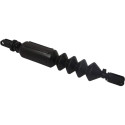
Installing and adjusting your trim tabs
Positioning on the transom
Your flap blades are attached to the lower part of the transom, on either side of the engine(s). Maintain a recommended distance of 15 to 20 cm between the outer edge of the blade and the end of the transom. Maintain a minimum of 10 cm between the blade and the engine to avoid interference with the propeller flow. The blades must be perfectly symmetrical and aligned horizontally.
Electrical installation
The wiring is 12V or 24V depending on your model. Connect directly to your batteries via a dedicated circuit breaker with a 20 to 30A fuse depending on the power. Mount the flap controller on your dashboard, within reach of the pilot. Two buttons or a joystick allow you to control each flap independently. Some controllers have LEDs that indicate the position of the flaps in real time.
Learning and optimal adjustment
Perform your first tests in calm seas, with your boat lightly loaded and at cruising speed. Activate the trim tabs in short pulses of 0.5 to 1 second, then allow your boat to react before making any further corrections. The reaction time varies depending on the size and speed of your boat, generally between 2 and 5 seconds. Observe the position of the bow in relation to the horizon: your goal is to have the boat perfectly level on the water.
Use your trim tabs according to the conditions
When starting and cruising
Lower your trim tabs completely when starting: the bow remains low, you maintain visibility, and the boat planes more quickly. As soon as your boat is planing, raise them gradually. In calm seas while cruising, raise them three-quarters of the way to optimize your maximum speed and minimize fuel consumption.
In rough seas
Lower your trim tabs so that the lowered bow cuts through the waves instead of hitting them. This will drastically improve comfort. Adjust carefully according to the height of the swell: lowering the trim tabs too much could cause the bow to plunge into a large wave.
Caution: following seas
Raise your trim tabs completely in following seas, in narrow channels, or when facing breaking waves. This is essential: otherwise, you risk burying the bow and losing control of the rudder.
Correcting heel
To correct a lateral tilt, lower the flap on the side opposite the tilt. For example, if your boat is leaning to port due to the wind, lower the starboard flap slightly. Proceed in small increments and observe the reaction with a delay of 2 to 3 seconds.
Special cases
In shallow water, lower your trim tabs before accelerating to lift the stern and protect your propellers. If your boat is "porpoising" at high speed (the bow rises and falls sharply), lower the trim tabs in small increments until stabilization is achieved.
Maintain your trim tabs and trim
Routine maintenance
Rinse your trim tabs thoroughly with fresh water after each outing, paying particular attention to the cylinder joints and the edges of the tabs. Activate them several times during rinsing to clean the inside of the mechanism.
Every month, check the tightness of the mountingscrews and the condition of the protective cover on the cylinders. Lubricate the joints with marine grease.
For hydraulic flaps, check the oil level in the reservoir every month and inspect the circuit for leaks.
A complete hydraulic oil change is required every year, with replacement of filters and inspection of seals.
Annual service
Once a year, remove the fins for a thorough cleaning. Inspect for corrosion and treat any oxidized areas with a protective spray. Replace any hardened or cracked seals. Check the electrical connections in the compartment for any oxidation of the contacts.
Winter storage
Raise your trim tabs to the upper position to prevent debris accumulation. Spray a protective lubricant on exposed metal parts and disconnect them electrically.
If your boat remains in the water, operate the trim tabs once a month to keep the mechanisms moving.
Summary: what you need to remember
Installing trim tabs on your boat will radically transform your boating experience. These movable wings attached to the transom save you 15 to 30% in fuel, improve your comfort in rough seas, and maintain optimal visibility from the moment you start the engine. It's an investment that quickly pays for itself.
For the vast majority of boaters, 12V or 24V electric trim tabs are more than sufficient. They are easy to install, require no hydraulic pump, and need minimal maintenance. Reserve hydraulic models for boats over 15 meters or for intensive professional use.
The size is based on the length of your boat: simple standard jacks for boats between 6 and 15 meters, reinforced models for boats longer than that. Refer to the sizing chart to choose the right size of flaps and the right power for your boat.
Learn how to use your trim tabs according to the conditions: lowered at start-up to keep the bow down, raised three-quarters of the way up when cruising in calm seas, lowered in rough seas to cut through the waves. Be careful to always raise them completely in following seas to prevent the bow from digging in. You can easily correct the heel by operating the trim tabs independently.
Maintenance is simple: rinse with fresh water after each outing, check the screws and lubricate the joints monthly, and have hydraulic models serviced annually. These preventive measures will ensure the longevity of your installation.
Invest in a quality system, size it correctly for your boat, maintain it regularly, and enjoy a transformed sailing experience. Your trim tabs will quickly become indispensable.
FAQ – Your questions about trim tabs
Are trim tabs really necessary on a small boat?
For boats measuring 6 to 7 meters with a powerful outboard motor of over 100 hp, trim tabs provide real comfort and measurable savings. Below this size, engine trim is generally sufficient. Above 8 meters, trim tabs become almost indispensable.
Can you install trim tabs yourself?
Yes, if you are handy and have the right tools, such as a powerful drill, a hole saw, and sealing materials. Follow the manufacturer's instructions carefully. The critical points are drilling the transom, which requires perfect sealing, and precise alignment of the blades. Allow half a day to a full day for the job.
Do the flaps work when the boat is stationary?
Technically, yes, the cylinders can move, but without effect because water flow under the hull is necessary to create lift. The flaps only work when sailing, once your boat reaches 8 to 10 knots.
What is the lifespan of a flap system?
Electric cylinders last 10 to 15 years with proper maintenance. Hydraulic cylinders last 15 to 20 years if you change the oil regularly. Stainless steel blades have an almost unlimited lifespan unless they suffer a major impact. The electronic controller generally lasts between 8 and 12 years.
Can trim tabs replace trim?
No, they are complementary. Trim optimizes the propeller's thrust angle, while flaps correct the boat's trim. Used together, they offer the best compromise between performance, fuel consumption, and comfort.