
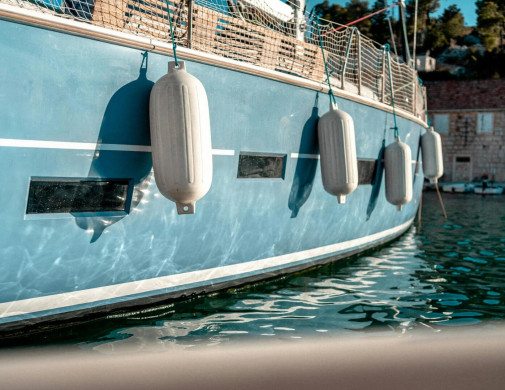
The different types of fenders
Inflatable or foam fenders?
The choice between an inflatable PVC model and a foam fender depends on your use and the space available on board. Each technology has its advantages depending on your needs.
Inflatable fenders are the market standard. Their PVC bladder inflates to between 0.15 and 0.2 bar and is covered with a fabric cover that protects your hull. They effectively absorb shocks and deflate for compact storage in your lockers. You simply need to inflate it before use and check the pressure regularly. With proper maintenance, it will last between 5 and 8 years. The accessible inflation valve makes it easy to adjust the pressure, and there are many models available in different colors and sizes.
The polyethylene foam fender offers permanent buoyancy without the risk of deflation. Always ready for use, it is ideal for regattas, frequent maneuvers in locks, and as an auxiliary fender. Although more bulky than an inflatable model, its rigid shape makes it easy to store.
Be careful in strong winds: its lightness can cause it to float up, but a simple trick is to wet it with a damp cloth to keep it in place. Although lighter, it is less resistant to repeated impacts than PVC. Nylon-covered models prevent scratches on your hull and are an excellent choice for river navigation or narrow spaces.
Shapes: cylindrical, spherical, or flat?
Cylindrical fenders are the most common and versatile. You can position them vertically or horizontally as needed. Models with eyelets or rings at both ends offer secure attachment and excellent durability.
There is also a more economical through-type version with a central rope: the cylinder rolls freely and maintains constant contact with the dock as you move.
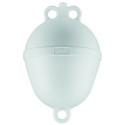
The spherical fender has an optimal round shape to absorb shocks from all directions. It rolls easily along your hull and self-positions at the point of contact. Particularly effective in locks, narrow passages, and when mooring alongside, it moves quickly in an emergency. You can even use it as a temporary mooring buoy. Choose it as a flying fender, a mobile reserve that is always ready to intervene.
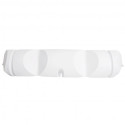
The flat fender protects a large area while minimizing bulk. Its dense foam covered with durable nylon is ideal for locks, boat launches, and as a complementary fender. Lightweight, it stores easily between two cylindrical fenders.
Be careful in windy weather: it can lift up and lose its effectiveness. You will find it particularly useful in tight spaces, to protect catamaran floats or private pontoons.
Dimension your fenders correctly
The optimal size is based on the 2/3 freeboard rule: the length of the fender must be at least 2/3 of the freeboard height (vertical distance between the waterline and the deck).
A fender that is too short will rise up during impacts, leaving the hull unprotected. If it is too long, it will interfere with maneuvering and take up valuable space in the lockers.
Measure your freeboard at the midship (widest part of the boat) for an accurate calculation.
Sizing chart based on the length of your boat
| Boat length | Fender diameter | Minimum number | Spacing |
| 3 to 6 m | Ø 9-12 cm × 40-50 cm | 6+1 flying | 1.5 m |
| 6 to 8 m | Ø 12-20 cm × 50-60 cm | 8+1 flying | 2 m |
| 8 to 10 m | Ø 20-25 cm × 60-70 cm | 8+2 volant | 2.5 m |
| 10 to 14 m | Ø 25-35 cm × 70-90 cm | 10+2 shuttlecocks | 3 m |
| 14 to 20 m | Ø 35-50 cm × 90-120 cm | 12+2 flaps | 3.5 m |
Flying fenders
Always have at least one spherical fender accessible on deck. This mobile fender can be quickly moved to protect exposed areas during delicate maneuvers or in poor weather conditions.
Adapt according to your use
- Occasional coastal navigation: Minimum number is sufficient. Prioritize quality over quantity. Invest in fenders with reinforced eyelets.
- Permanent mooring in port: Provide 2-3 additional fenders to double protection on the dock side during storms. Install permanent fenders supplemented by flying fenders.
- River navigation (frequent locks): Combine cylindrical and flat fenders. Flat fenders protect a large area during repeated contact with lock walls. Minimum of 10 fenders for a 10-meter boat.
- Mooring alongside: Double the number of fenders on the mooring side. Use spherical fenders between hulls to absorb multidirectional shocks. Protect stanchions with additional fenders.
Position your fenders strategically
Priority locations: the beam first
Install your first fender at the midship, the widest part of your boat. This is the area of maximum contact when mooring, and therefore the most critical point. If you are exposed to wind or current, double the fender at this location.
Then space your second and third fenders on either side of the beam according to the spacing chart. Be sure to cover at least 75% of the length of your boat.
Add extra fenders to specific areas: one at the bow for forward maneuvers, one near the transom for protection when reversing. On sailboats, also protect the stanchion outlets.
Fastening: capstan knot + half hitch
Recommended attachment points:
- Cleat bases (most secure)
- Gunwale rail
- Dedicated fender cleats
- High fenders (only if limited stress)
For the fastening technique, master the capstan knot secured with a half hitch. The capstan tightens under tension while remaining easy to undo for adjustment. The half hitch allows for quick loosening without completely undoing the knot. Tighten firmly after final positioning.
Adjust the height correctly
A fender that is too high will pass over the dock and leave your hull unprotected. If it is too low, it will drag in the water, get unnecessarily dirty, and lose its effectiveness. Ideally, align the center of the fender with the usual contact line between your boat and the dock. Check this setting when the dock is empty and when it is full, as the water level varies.
In ports with significant tidal ranges, adjust according to the tidal coefficient.
After installation, perform a simple test: give your boat a slight sideways movement and check that the fender makes contact before any other part of the hull. Readjust if necessary.
Inflate and maintain your fenders
Inflation: the ideal pressure
Inflate your fenders with a specific manual pump or a gas station pump in progressive pressure mode only. Never use a high-pressure compressor.
Insert the inflation nozzle into the valve and pump until you feel moderate resistance under the pressure of your hand. The fender should sink slightly (1 to 2 cm) when you press firmly with your thumb. A fender that is too soft does not provide sufficient protection, while over-inflation may cause it to bounce off the obstacle or even burst.
Here is a simple test: press firmly with your flat hand on the fender. If it sinks more than 3 cm, it is underinflated. If you encounter immediate total resistance, it is overinflated. The ideal is somewhere in between: a gradual sinking with slight resistance.
Check the pressure every 3 to 4 weeks, as a natural loss of around 10% per month is normal. Always re-inflate before exposure to difficult conditions such as a forecast storm or heavy swell.
Maintenance and lifespan
Rinse your fenders with fresh water after each use to remove salt, sand, and dirt. Pay particular attention to the valve and the eyelet attachment area, then let them dry before storing.
Once a year, clean them thoroughly with a specific PVC product, such as those used for tires. Avoid aggressive solvents that weaken the material. Then apply UV protection to extend their lifespan.
To remove black rubber marks from your white hull, use black soap or a specific product. For the fender itself, a PVC cleaner and a soft brush are sufficient. Better still, prevent these marks by using fabric covers.
Before winter storage, partially deflate your fenders, leaving about 50% of the pressure to avoid permanent creases. Store them in a dry place, away from UV rays, without ever folding them. Hang them up if possible or lay them flat. The ideal storage temperature is between 10 and 20°C.
Replace your fenders as soon as you notice any of the following signs of wear: cracks in the PVC due to excessive UV exposure, rapid loss of pressure indicating a defective valve or micro-leak, significant discoloration revealing weakened material, irreparable tears in the fabric cover, or torn eyelets.
Additional equipment
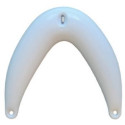
Depending on your configuration, you can supplement your equipment with specialized fenders: bow fenders to protect the bow during maneuvers, pontoon fenders for fixed installation, or mooring buoys to mark your temporary moorings.
Textile covers protect your fenders from UV rays and prevent marks on the hull. Stainless steel storage racks free up space in your lockers by keeping your fenders organized on the balcony.
Summary: key points to remember
Protecting your hull starts with properly sized and positioned fenders. These fenders are your first line of defense against impacts at the dock, friction in locks, and contact with other boats.
Remember the 2/3 rule: the length of your fenders should be at least two-thirds of the height of your freeboard. For a boat between 6 and 8 meters, you will need 6 cylindrical fenders plus 1 spherical fender. Increase this number proportionally for larger boats, following the sizing chart.
Inflatable PVC fenders are the market standard: sturdy, effective, and compact when deflated. Foam models are suitable for regattas and as auxiliary fenders. Choose cylindricalfenders for versatile use, spherical fenders as mobile flying fenders, and flat fenders for locks or narrow spaces.
Position your first fender at the midship on each side, then space the others evenly. Secure them with a bowline knot secured with a half hitch, and adjust the height so that the center aligns with the usual contact line. Always retract your fenders when sailing: they create significant drag and may be torn off.
Maintenance is simple: rinse with fresh water after each outing, check the pressure every 3 to 4 weeks, and store them away from the sun. Well-maintained fenders will last 5 to 10 years and save you from costly hull repairs.
FAQ – Your frequently asked questions about fenders
How many fenders should you have at a minimum?
For a boat measuring 6 to 8 meters, you should have at least 6 cylindrical fenders plus 1 spherical fender. Increase this number proportionally according to the sizing chart for larger boats. The principle is simple: it is better to have one too many fenders in your lockers than a damaged hull. Never sail with insufficient equipment.
Horizontal or vertical fenders?
It depends on the configuration of your pontoon and hull. Vertical positioning remains the standard for conventional side mooring. Opt for a horizontal position if your freeboard is limited, for river navigation, or for extended protection along a flat hull. Some sailors alternate between the two positions to optimize their coverage.
Which color should you choose?
Bright colors such as red, orange, or yellow offer better visibility if you use your fender as a temporary mooring buoy. White or ecru provide aesthetic discretion but get dirty quickly. Navy blue or black hide dirt better, but be careful: these dark colors heat up more in the sun, so remember to check the pressure regularly. Note that some marinas require uniform colors to harmonize all berths.
Can a punctured fender be repaired?
Yes, with a PVC repair kit (like a tire repair kit ). Clean the damaged area, sand it lightly, apply a patch and special PVC glue. Let it dry for 24 hours before re-inflating. If the tear is longer than 5 cm or is located near the valve/eyelet, replacement is recommended.
How can black marks on the hull be avoided?
There are three solutions: install fabric covers on the fenders (the most effective), use white/light-colored fenders that leave fewer marks, or place a damp cloth between the fender and the hull during long-term mooring.
Clean your hull regularly with specific products to remove fresh marks before they become ingrained.
Are fenders allowed when sailing?
No, you must retract your fenders as soon as you set sail. There are only a few exceptions: harbor maneuvers, passing through locks, and sailing in congested areas at reduced speed. Fenders left trailing while sailing create excessive drag, increase your fuel consumption, and risk being torn off.
What should you do if a fender deflates at sea?
Use your spare fender: this is precisely why you should always have one on board. If you don't have one handy, improvise temporary protection with cushions, foam vests, or rolled-up clothing that you can tie securely. If your fender has simply lost pressure, reinflate it manually through the valve. If it is punctured, wait until you are docked to repair it.