

The dampening system: overview
Components of the complete system
An effective mooring system incorporates seven interdependent elements, from the attachment point to chain storage:
- Anchor: attachment point to the seabed (grapple, plate, plow)
- Chain and ropes: connection between anchor and boat, absorbs shocks
- Davit: guides the chain from the deck to the water
- Windlass: mechanically raises the anchor
- Chain locker: stores chain and anchor on board
- Mooring cleats: attachment points for mooring lines
- Fenders: protect the hull from contact with the dock or other boats
Overall sizing principle
Dimensioning is based on the weight and length of the boat. As a general rule, provide an anchoring system capable of holding the boat in wind force 7 (30 knots). The anchor weighs 1 to 1.5 kg per meter of boat length. The chain is 3 to 5 times the maximum anchoring depth. The cleats support 10 times the displacement of the boat. Each component must be consistent with the others to avoid a weak link.


Boat protection: fenders and rub rails
Sizing your fenders
Fenders absorb shocks between the boat and the dock or between boats. Their size determines how effective they are. Three parameters are important: diameter, length, and number.
| Boat length | Fender dimensions | Minimum number | Spacing |
| 6 to 8 m | Ø 15 × 50 cm | 6 | 1.5 m |
| 8 to 10 m | Ø 20 × 60 cm | 8 | 2 m |
| 10 to 12 m | Ø 25 x 70 cm | 10 | 2.5 m |
| 12 to 15 m | Ø 30 x 90 cm | 3 m |
2/3 freeboard rule: the height of the fender must be at least 2/3 of the vertical distance between the waterline and the deck. On a sailboat, position the fenders at the midship (widest part). On a motorboat, center them on the usual contact area.
How to choose your boat fenders?
Specific fenders and buoys
- Pontoon fender: fixed protection for private pontoons, UV and weather resistant
- Stern/bow fender: spherical or pear-shaped, absorbs angular impacts during maneuvers
- Mooring buoys: indicate the location of the mooring, Ø 30-40 cm depending on exposure
- Fender socks: textile protection, prevents black marks on the hull
Essential deck fittings
Cleats: types and strength
The cleat is the point of attachment for mooring lines. Its strength determines how well the boat holds to the dock. There are three main types:
- Standard cleat (T-shaped): universal, load capacity 500-2000 kg depending on size
- Clamp cleat: locks the mooring line without knots, saving time during maneuvers
- Cross cleat: multi-directional mooring, ideal for the bow
| Boat length | Cleat size | Recommended load |
| 6 to 8 m | 150-200 mm | 800-1200 kg |
| 8 to 12 m | 200-250 mm | 1500-2000 kg |
| 12 to 15 m | 250-300 mm | 2500-3500 kg |
Attach your cleats to a frame or reinforcement, never to plywood alone, which would not withstand the stress. Allow for at least 4 cleats per boat: 2 at the bow and 2 at the stern. In a marine environment, always choose 316 stainless steel for its corrosion resistance.
Davits and hawse pipes
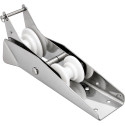
The bow roller guides your anchor chain from the deck to the water, preventing friction and scratches. Its inverted U-shape must accommodate both the diameter of your chain and the shank of the anchor. Position it at least 1 meter from your windlass to prevent jamming during maneuvers.
The fairlead is a reinforced opening in the hull or deck that allows the chain to pass through. Its stainless steel protective ring has a diameter 50% greater than the diameter of your chain to ensure smooth passage.
The chain passage forms a channel that guides the chain from the hawsehole to the storage well. Its smooth walls and minimum slope of 45° allow the chain to flow naturally without snagging.
Ropes and mooring lines: choosing the right ones
Size your mooring lines
Plan for at least two mooring lines, each 4 meters long, plus two additional mooring lines to balance your boat. Add 50% extra length for maneuvering and knots. The ideal distance from the dock is between 1.50 and 2 meters, or 1 meter if you are using a gangway.
| Boat length | Mooring line diameter | Total length | Recommended type |
| 6 to 8 m | 12-14 mm | 4 x 6 m = 24 m | Braided polyester |
| 8 to 10 m | 14-16 mm | 4 x 9 = 32 m | Greased nylon |
| 10 to 15 m | 18-20 mm | 4 x 10 m = 40 m | Polyester/nylon |
Materials: advantages and disadvantages
- Braided polyester has low elasticity and is UV resistant. Its excellent value for money makes it the ideal choice for permanent mooring.
- Nylon or polyamide offers high elasticity of 20 to 30%, which absorbs shocks and waves. It is ideal for mooring in rough seas.
- Polypropylene floats and is economical, but its low UV resistance limits it to temporary use only.
- Finally, Dyneema or Spectra combines ultra-strength and lightness, but its high cost limits it to professional or competitive use.
Mooring shock absorbers: comparison
Shock absorbers absorb the movements of your boat caused by wind or swell, protecting your cleats and mooring lines from excessive stress.
- The rubber model is quiet, lightweight, and does not scratch. It lasts between 3 and 5 years at an average cost.
- Galvanized steel springs offer strength and economy, but oxidize quickly and become noisy. They have a lifespan of 5 to 8 years.
- The stainless steel spring never rusts, has a neat appearance and is highly resistant. Despite its heavy weight, it lasts more than 15 years but remains expensive.
- The silent spring combines a plastic sheath on a stainless steel spring to combine silence and strength: it is the top of the range.




Additional equipment
Bow and stern thrusters
For boats measuring 10 to 12 meters or more, thrusters greatly facilitate mooring and casting off in crosswinds. A bow thruster alone is sufficient for most uses.
Add a stern thruster on boats over 15 meters or with a strong keel effect. Allow 1 kg of thrust per ton of displacement, with a minimum of 3 kg for real efficiency.
Buoys and floats
Anchor buoys or mooring buoys require a diameter of 30 cm for boats between 6 and 10 meters, and 40 cm for boats over 10 meters. Choose bright colors for better visibility.
For your inflatable dinghy, opt for a rigid floor for boats over 2.50 meters. A high-pressure inflation system at 0.25 bar improves rigidity and seaworthiness.
Protection of mooring lines
Textile or leather over-sheathing prevents abrasion of your mooring lines at friction points such as stanchions, lifelines, and cleats. Position them halfway along and at the ends.
Secure them with sail thread; never glue them. This protection extends the life of your mooring lines by 50%. As an economical alternative, opt for a heat-shrinkable ring sleeve.
Essential knots
Master the cleat knot with its dead turn, figure eight, and reverse half hitch. It allows for quick release, which is essential.
The capstan knot, consisting of two reverse half hitches, remains simple and effective for mooring on a ring. The splice creates a permanent connection between the eye and the rope, retaining 95% of the breaking strength.
Summary: what you need to remember
Your mooring system must be sized overall based on the weight and length of your boat. Plan for equipment capable of holding your boat in a force 7 wind. The anchor represents 1 to 1.5 kg per meter of boat, the chain measures 3 to 5 times the maximum mooring depth, and each component must be consistent with the others to avoid a weak link.
Fenders provide daily protection against impacts at the dock. Follow the 2/3 freeboard rule for sizing and allow for a minimum of 6 cylindrical fenders plus 1 spherical fender for a boat of 6 to 8 meters. Position them at the midship as a priority, space them evenly according to the table, and always retract them when sailing to avoid drag and tearing.
Deck fittings require mooring cleats with a load capacity that greatly exceeds the weight of your boat. Attach them to a frame or reinforcement, never to plywood alone. The bow roller guides your chain without friction and must be positioned at least 1 meter from the windlass. The fairlead and chain plate ensure smooth passage to the storage well.
Your mooring lines should be sized according to the length of the boat: for an 8 to 10 meter vessel, use 14 to 16 mm rope with 4 mooring lines, each 8 meters long. Braided polyester is suitable for permanent mooring, while nylon absorbs shocks from swells better. Add shock absorbers to protect your cleats and mooring lines from surges caused by wind or swells.
Additional equipment makes maneuvering easier and improves your comfort. Bow thrusters are useful for boats 10 to 12 meters long, mooring buoys mark your anchorages, and over-sheaths protect your mooring lines from abrasion at friction points. Master the three essential knots: the cleat knot for quick release, the capstan knot for mooring on a ring, and the splice knot for a permanent connection.
Adopt an eco-responsible approach by favoring sandy anchorages and avoiding Posidonia seagrass beds at all costs, as you could face a fine of up to €15,000. Always raise your anchor vertically to limit scraping of the seabed, rinse your mooring line after use, and comply with local regulations. Consult apps such as Donia or Géoportail to identify protected areas before anchoring.
FAQ – Your frequently asked questions about mooring
How many mooring lines should I bring as a minimum?
The absolute minimum is four mooring lines: two 4-meter lines at the bow and two 4-meter lines at the stern. However, we recommend that you bring six so that you can double them up if necessary. For boats longer than 10 meters, add two cross mooring lines for better balance.
Can we moor directly to a mooring box?
Yes, if the bollard is new and well maintained. Check the load capacity displayed and double your mooring line if you are exposed to wind or swell. Also check that there is no corrosion on the surface shackle. If you have any doubts about the condition of the bollard, it is safer to anchor instead.
Which anchor to choose: plow, flat, or grapple?
Plow anchors, such as CQR or Delta models, remain the most versatile and are suitable for all types of seabed. Flat anchors, such as Danforth anchors, excel in sand and mud while remaining compact. Grapple anchors are suitable for rocks, dense seaweed beds, and small boats. For your main use, choose a plow anchor whose weight is 150% of the recommended weight for your boat.
How do I size my anchor chain?
For length, allow 3 to 5 times the maximum depth of your usual anchorage, with a minimum of 40 meters for coastal navigation. For diameter, use 6 mm for boats up to 7 meters, 8 mm for 7 to 10 meters, 10 mm for 10 to 13 meters, and 12 mm for anything larger. Always choose a Grade 3 marine-grade galvanized or stainless steel chain.
Is a bow thruster mandatory?
No, it is not mandatory but is strongly recommended for boats over 12 meters or for solo sailing. The investment varies between €3,000 and €8,000 depending on the power. As an alternative, you can perfect your spring maneuvering technique. Removable pod systems are less efficient but more affordable.